Wednesday, August 31, 2005

Beliefnet Quiz

About once every week or so I search "Adventist" on Technorati to see who's blogging about my church and what they're writing. The majority of occurrences of the word on blogs are in results from a "Belief-O-Matic" quiz on Beliefnet.com that supposedly tells you what faith group you most closely align with (if you didn't already know). Well, I figured today I'd finally break down, take the quiz, and see how orthodox (not that Orthodox) I am.

After warning me that it assumes no "legal liability" for my "ultimate fate" (nice to know I'm in good hands), the Belief-O-Matic rendered these results:

1. Seventh Day Adventist (100%)

2. Orthodox Quaker (94%)

3. Eastern Orthodox (91%)

4. Roman Catholic (91%)

5. Mainline to Conservative Christian/Protestant (88%)

6. Mainline to Liberal Christian Protestants (63%)

7. Hinduism (61%)

8. Orthodox Judaism (60%)

9. Islam (48%)

10. Jehovah's Witness (48%)

11. Liberal Quakers (48%)

12. Church of Jesus Christ of Latter-Day Saints (Mormons) (46%)

13. Sikhism (44%)

14. Baha'i­ Faith (42%)

15. Unitarian Universalism (38%)

16. Jainism (36%)

17. Mahayana Buddhism (29%)

18. Theravada Buddhism (28%)

19. Reform Judaism (27%)

20. Neo-Pagan (27%)

21. New Age (20%)

22. Secular Humanism (20%)

23. Christian Science (Church of Christ, Scientist) (18%)

24. Nontheist (15%)

25. Scientology (15%)

26. Taoism (14%)

27. New Thought (11%)

Well, I guess I'm well within the Adventist fold, except that I took the quiz twice. The difference between "Orthodox Quaker (100%)" and what you see here hinges on whether I believe baptism is necessary for salvation or not. Unfortunately the Belief-O-Matic doesn't offer the option of a nuanced answer on that point. Maybe that's a topic for another post...

Tuesday, August 30, 2005

Vaughan Williams and Herbert

Ralph Vaughan Williams (pronounced "rafe vawn") is one of my favorite composers. His music is rich, British, and evocative. Vaughan Williams probably best known for his Fantasia on Greensleeves and the Fantasia on a Theme by Thomas Tallis, which was used extensively in the film Master and Commander. However, tonight I want to share with you the lyrics to one of his Five Mystical Songs.

Five Mystical Songs is a lesser known work by Vaughan Williams in which he set five poems by the fifteenth century poet George Herbert to music for baritone. I once had the privilege of singing in the chamber choir that accompanies some of the songs for a friend's senior recital. It was an unforgettable experience, and Glen Graham is probably the best male vocalist I will ever have the privilege to sing with.
"Love Bade Me Welcome"

Love bade me welcome: yet my soul drew back,
Guilty of dust and sin.
But quick-ey'd Love, observing me grow slack
From my first entrance in,
Drew nearer to me, sweetly questioning
If I lack'd anything.

A guest, I answer'd, worthy to be here:
Love said, you shall be he.
I the unkind, ungrateful? Ah, my dear,
I cannot look on thee.
Love took my hand, and smiling did reply,
Who make the eyes but I?
Truth Lord, but I have marr'd them: let my shame
Go where it doth deserve.
And know you not, says Love, who bore the blame?
My dear, then I will serve.
You must sit down, says Love, and taste my meat.
So I did sit and eat.
Lyrics taken from the jacket of a Vaughn Williams CD on the Hyperion label.

New Picture

Phantom Ship Island, Crater Lake, Oregon, USA

I'm going to use this picture of Phantom Ship Island in Crater Lake National Park for my title bar. It was taken on a day when forest fires had filled the crater with smoke, creating a endless horizon effect.

Monday, August 29, 2005

Top Five Combos For A Rainy Day

Today is a overcast, rainy, cold day in Northwestern Alberta. The farmers really didn't need this right now, and neither did I. There is something about rainy days that takes away any motivation I might have otherwise had and makes me want to lay around the house avoiding any physical activity. Thus I submit for your consideration my favorite synergistic combinations of lazy activities (an oxymoron?) for a dark, damp, depressing day.

Top Five Combos For A Rainy Day:
  1. Reading The Lord of the Rings trilogy by J.R.R. Tolkien while listening the The Planets by Gustav Holst.
  2. Watching Monty Python and the Holy Grail while eating frozen pizza (after it's been baked in the oven) doctored with garlic powder, basil, oregano, and fresh mushrooms and onions.
  3. Reading the Bible commentary Revelation of Jesus Christ by Ranko Stefanovic while listening to A Bach Festival by the Empire Brass.
  4. Cuddling with my wife in bed while delaying our eventual departure from its warmth and comfort.
  5. Blogging in one Firefox tab while checking the conversations on HeavenlySanctuary.com in the other.

Sunday, August 28, 2005

Sermon Summary 8-27

The the Sermon on the Mount in the gospel of Matthew contains a startling statement: "Therefore You are to be perfect, as your Heavenly Father is perfect (Matt. 5:48). Many have used these words to justify a perfectionist attitude characterized by a strict obsession with proper behavior and an intolerance of mistakes. But it seems that they have failed to notice the way Luke phrases Jesus' words in his account of the same sermon--"Be merciful, just as your Father is merciful" (Luke 6:36).

It would seem that some Christian perfectionists have an imperfect understanding of what the Bible has to say on the topic, because 'merciful' isn't usually the first word that pops into your head when you think of such a person. I think this is because they fail to realize that perfection in the Bible isn't about behavior. Luke doesn't say, "Do merciful deeds"; but rather "Be merciful."

Perfection is easy to achieve when it means
trying to be like other 'perfect' people, pointing out and condemning others mistakes, and not focusing on the big issues that we have in our own lives (Luke 6:37-42). But it's a little more difficult when we realize that our standard of perfection is the attitude Jesus had and that good deeds are not just obeying the rules but are judged by the effects that they have on others (fruit). It's even harder to achieve when we come to understand that perfection produces behavior, and not the other way around (Luke 6:43-45).

Perfection is impossible without Jesus, "the author and perfecter" of our faith (Heb. 12:2). He's the only one who has the ability to take out our imperfect, unmerciful mindsets and replace them with a perfect, merciful mind that reflects who he is. This doesn't mean we won't make mistakes some times, because perfection is a process. Paul says that those who are perfect will realize that they aren't (Phil 3:12-15). But we can continue on nevertheless, because with Jesus as our perfection and forgiveness we have nothing to fear (1 John 2:1).

Friday, August 26, 2005

Bible Studies: 8 The Great Controversy

My internet was down last night (cable bottlenecks), so I published yesterday's post this morning. Nevertheless, I'm going ahead with next installment of my Bible study series on the Fundamental Beliefs of the Adventist church. You can use the Bible Study Tools Search on the side bar to look up texts, and the 'answers' are at the bottom of the post. You can find the previous study in the archive.

These studies are a work in progress, so comments and criticism are appreciated. Enjoy.

Study 8: The Great Controversy

1. The Great Controversy started with the r_________ of Satan against God (Isa. 14:12-14, Eze. 28:12-18, and Rev. 12:3,4).

2. The result was a spiritual w___ that encompasses heaven and earth (Rev. 12:7-9, Eph. 6:12).

3. S_________ is the result of this conflict (Gen 4:1-8).

4. Battles in this war are over whether our relationship God is based on l____ or f____ (Job 1:6-12).

5. At the c_____, Jesus proved that God’s character is good and defeated Satan (John 12:23-33).

6. To win the conflict God seeks to bring peace by r___________ us to Himself and each other (Eph. 2:12-22).

7. God takes responsibility for evil by using His p_____ to intervene when things get too bad (Gen. 6:5-8).

8. God will intervene again to end the war, but not before everyone has a chance to be r_______ (2 Peter 2:4-10 and 3:3-9).

9. Do you see God as the author of the story of your life or a character in it?


1.
Rebellion. 2. War. 3. Suffering. 4. Love, Fear. 5. Cross. 6. Reconciling. 7. Power. 8. Rescued.

Rational Religion

I read an article on Slate.com some time ago about the logician Kurt Gödel and his incompleteness theorem. The theorem states, as Slate's Jordan Ellenberg summarized it:

Given any system of axioms that produces no paradoxes, there exist statements about numbers which are true, but which cannot be proved using the given axioms.

And Gödel not only stated this theorem; he proved it (see the article for details).

I'm going to make an analogy between Gödel's mathematicalcal thinking and my theological thinking--bearing in mind Ellenberg's cautionary statementent: "Any scientific result that can be approximated by an aphorism is ripe for misappropriation." The similarity between Gödel and myself is that my rational study of the Bible has led me to the same irrational place (There's only one irrational place, right?) that his rational study of logic led him. In Gödel's terms, here is the result of my theological thinking:

Given any system of dogmata that produces no paradoxes, there exist statements about God which are true, but which cannot be proved using the given dogmata.

What led me to this conclusion was Jesus claim to be the truth. If this is the case then any system of statments about Him (or doctrine) will never reveal truth in its entirety, because truth can only be fully known by knowing (having a relationship with) the Person who is truth, Jesus.

So what now? Do I give up on rational enquiry of my faith? Forget my Greek and Hebrew? Throw out my theological books because their words cannot reveal their fullest meaning? Perhaps even leave behind the Bible in my quest for spiritual enlightenment?

I believe I overstate my case, as would someone who thinks Gödel's theorem proves mathematics to be a meaningless exercise. Did I mention that the title of that article was "Does
Gödel Matter? The romantic's favorite mathematician didn't prove what you think he did." Ellenberg explains why:

...what's most startling about Gödel's theorem, given its conceptual importance, is not how much it's changed mathematics, but how little. No theoretical physicist could start a career today without a thorough understanding of Einstein's and Heisenberg's contributions. But most pure mathematicians can easily go through life with only a vague acquaintance with Gödel's work. So far, I've done it myself. How can this be, when Gödel cuts the very definition of "number" out from under us? Well, don't forget that ...there are some statements that are true under any definition of "number"--for instance, "2 + 2 = 4."...Gödel's theorem, for most working mathematicians, is like a sign warning us away from logical terrain we'd never visit anyway.

I guess we don't have to give up on rationality, and I don't have to quit my blog. After all, there are statments that hold up under any Biblical understanding of God (e.g. "God is love.") All a statment like "Jesus is the truth" does is show us the boundaries of rational inquirey, not remove its usefulness altogether. Logic and reason are simply a tools we use to describe and comprehend truth, not the beginning and end of it.

So, I guess that means I can still parse the Greek, account for context, critique theological arguments, and use the Crosswalk.com Bible Study Tools I just added to apokalupto [shamless plug]. But now I'll be a little more humble as I do it and a little more lenient with those who don't see things exactly my way. And, hopefully, I'll always have in mind the reason why I study--to understand a good Friend a little better.

Adventist author Clifford Goldstien recently authored a book called God, Gödel, and Grace. I have not yet read it, but you can read reviews of it by those who have at Amazon.com.

Tuesday, August 23, 2005

Christian?

U.S. evangelist calls for assassination of Chavez

Wow, I didn't think it was possible for an evangelical Christian to be more hawkish than Bush. I guess Pat Robertson proved me wrong. According to Reuters:

"Robertson, the founder of the Christian Coalition and a presidential candidate in 1988, said [Venezuelan President Hugo] Chavez, one of Bush's most vocal critics, was a 'terrific danger' to the United States and intended to become 'the launching pad for communist infiltration [that's, like, sooo 1950s] and Muslim extremism.'

'We have the ability to take him out, and I think the time has come that we exercise that ability,' Robertson said during Monday broadcast of his religious 'The 700 Club' program. [Exactly the kind of brilliant foreign policy I would have advocated at age 14 during my Tom Clancy phase.]

'We don't need another $200 billion war to get rid of one, you know, strong-arm dictator,' he continued. 'It's a whole lot easier to have some of the covert operatives do the job and then get it over with.'"

Maybe Robertson has a different translation of the Bible than I do--One that says, "Love your neighbor as yourself....Unless he's got alot of oil." Or maybe it includes the line "Praise the Lord and pass the ammo" somewhere in the Lord's prayer. I don't know.

Now I'm not saying assassination attempts are necissarily evil. The famous theologian Dietrich Bonhoeffer was involved in an attempt on Hitler and with good reason. But just because the guy's a personal friend of Castro doesn't mean he's on the same moral level as a genocidal dictator. (Canadian Prime Minister Pierre Trudeau was also a friend of Cuba's dictator.)

Robertson's comment is sure to be all over the media (and the talk of the blogosphere). Just the kind of publicity Christianity needs to improve it's image. At least it's proved that no one has the 'corner' on the 'fundamentalist market'.

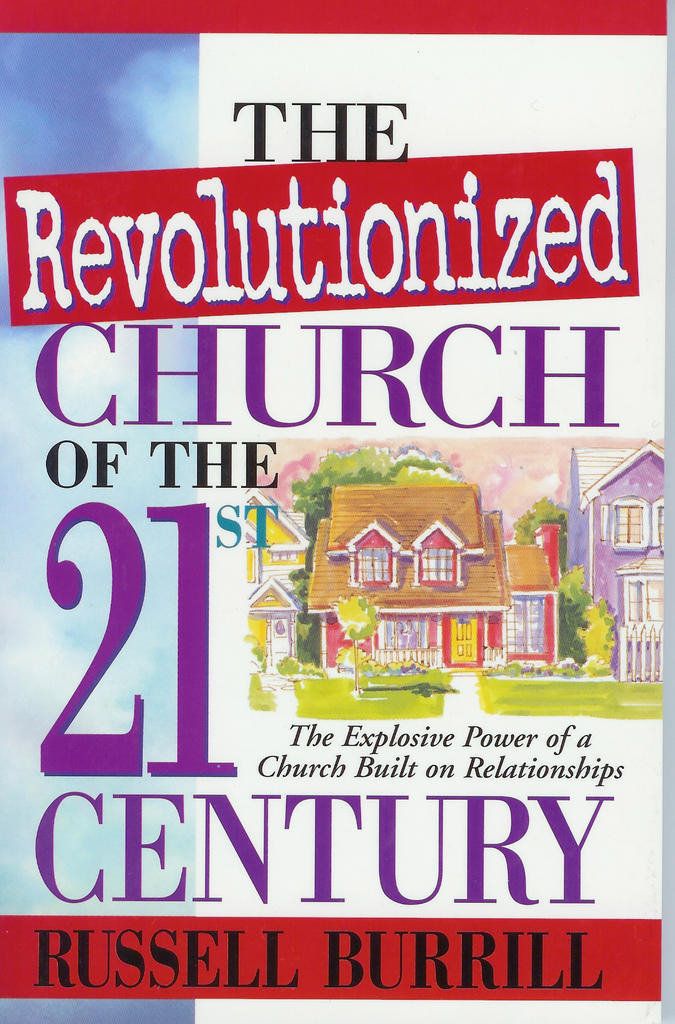
The Revolutionized Church of the 21st Century

The title of this post sounds terribly pompous, doesn't it? It's actually the title of a book I'm reading by Russell Burrill, a professor at the Andrews University Seminary and the director of the NADEI. The Revolutionized Church, the latest in a series Burrill rethinking the way Adventists "do church", focuses on the importance of relationships and small groups. These two paragraphs caught my attention:
The children of Cain build cities. Cities originate as people rebel from God and the community He wished to establish among His children. Broken relationships do not build community--they build cities where people are distant from one another. A city as defined here is not the literal city, although it can include that. Rather, a city is defined as any place where people are living close together but not in community. Many "country" churches in this sense are cities, fortresses where people hide from each other rather than live in dependence upon each other....

Unless a church develops small relational groups where people can find community, it is still partaking of the spirit of Cain in building a city rather than seeking to help people find real community. Cities are pseudo-communities. Millions of people are controlled by people in power. When this happens, there is no community, either in the world or in the church. The gathering of people into smaller groups results in the building of community. Churches that exist in the city, then, must concentrate on building community in the city rather than attempting to accumulate power. (The Revolutionized Church of the 21st Century, 34,35)
Properly functioning small groups distribute power. They make people participants rather than spectators, and when that happens those in charge loose some of their control. This is threatening for people who want to accumulate power in the church. They see "church" as people lined up in the pews listening to them, rather than people empowered to do great things. I pray that God will help me, as a pastor, to avoid the spirit of Cain.

To read the story of Cain click here.

Monday, August 22, 2005

Introducing Rob

I've asked my friend Rob to join apokalupto and help me spruce it up a bit with his knowledge of HTML. I met Rob at Canadian University College where we shared a mutual appreciation for the same TV shows, writing, racquetball, and sci-fi. (I also ended up marrying his cousin.) Rob's been doing web design for awhile now, so expect a few changes to the layout.

Sunday, August 21, 2005

Sermon Summary 8-20

There are some verses in the Bible that I call crazy texts, the kind we read and skip over because they're too crazy. A two examples would be "Rejoice in the Lord, again I will say, rejoice! (Phil. 4:4)", and "Consider it all joy, my brethren, when you encounter various trials (James 1:2)". Now I don't know anyone who likes suffering. How can God expect me to rejoice when I'm in trouble?

Suffering is probably the hardest thing for people who believe in God to explain. The argument goes: If God is good and God is all-powerful, how come there is evil? Therefore God is either weak, evil, or a fantasy.

But God is not just good and all-powerful. These are indeed attributes that God must have, but the Bible says the very essence of God is love (1 John 4:8). God is love and wants us to love Him back, but that love implies a choice. And when our first ancestors chose to believe that God is a liar they rejected his love and evil entered the world (Gen. 3).

So how did a God of love respond to this? He couldn't violate our freedom of choice, so He came and suffered with us (Is. 53:4-6). He did it so that He could set up the Kingdom of Heaven, a kingdom based on love, not fear. It is an upside-down kingdom where everything is the opposite of what you would expect of a human government (Matt. 5:1-10). And in this upside-down Kingdom of Heaven persecution is a good thing (Matt. 5:11-12).

The Apostle Peter says that Christians shouldn't be surprised when we have "fiery ordeals", but that we should rejoice to the degree that we share the "sufferings of Christ" (1 Pet. 4:12,13). God showed his love to us by coming and suffering with us, and one of the ways that we can show love back to him is by suffering for Him in persecution. When we do this we show Satan, the accuser who throws ordeals at us, that we don't "love" God because of what He gives us, but that we will do anything for Him because of who He is (Job 1:6-12).

This is why we can rejoice when troubles happen to us for no reason, because we have been given an opportunity to show our love for God, in the same way that He showed His love to us. To stand by Him no matter what, and to rejoice in a relationship of love that nothing can take away. And to relax in the certainty that our reward is indeed coming--an eternity with our greatest Friend.

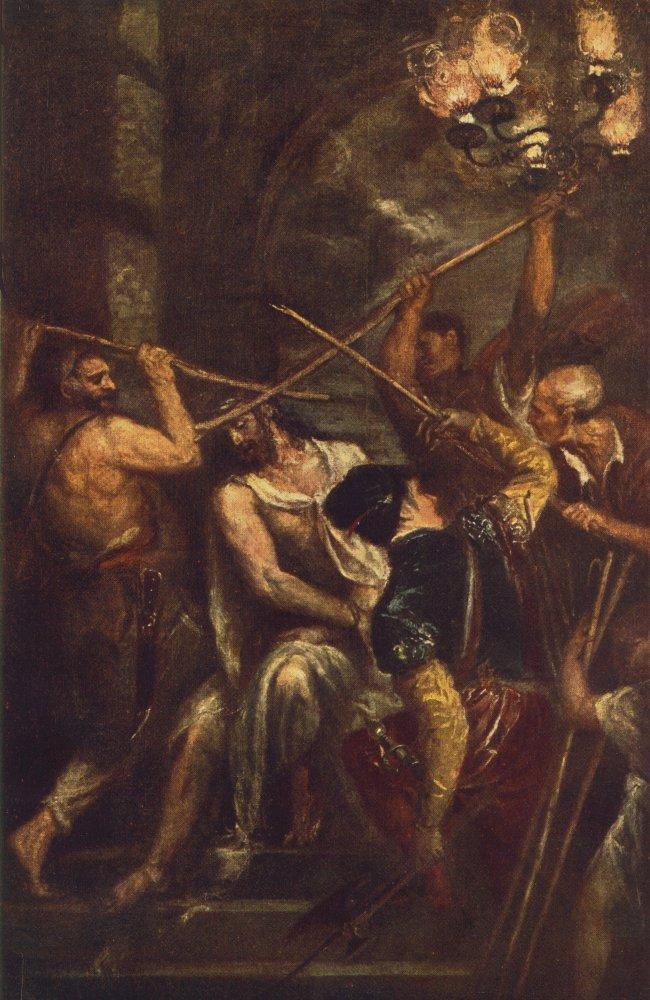
Crowing With Thorns is in the later style of the long lived, Venetian, renaissance painter, Titian.

Friday, August 19, 2005

Google Maps

Google Maps has got to be the hottest online map service with their new satellite imagery. I could waste hours playing with this feature. Just go to maps.google.com and type your address info into the search field (Yes, just one search field!). Now click the "satellite" button in the upper right hand corner of the map and, voila, an aerial photograph of your house. Click the "Hybrid" to get roads superimposed on top. And just click the mouse and drag to move the map.

For me Google Maps is just about as good as it gets. There are very few roads even out here in Northern Canada that don't show up. Their directions are also excellent, and there is even a search function that allows you to find various shops and services near your location. This alone puts them up over MapQuest and Yahoo Maps. But their international coverage is limited, so don't expect to use it to find your way around Budapest.

Click here to see a picture of my family's old house in Minnesota. I learned to canoe in the algae infested lake on the north boundary of our property.