The gospel writer Luke considered Jesus' crucifixion the defining moment of His life. He wrote more about it than any other story and presented Jesus life as proceeding to and from this event. From this perspective I suggest that we can learn much from Jesus' relationships on His journey from Pilate's court to His death on Calvary as recorded in Luke 23.
The first person Jesus meets on His journey is Simon, who is forced to help carry His cross (Lu. 23:26). Often we have a picture in our minds of Jesus going through the crucifixion in an aloof state, needing no ones assistance. Yet, this was not the case. True, there we some things only Jesus could do, but He sought (Lu. 22:39-46) and accepted support where He could. How much more do we need the support of relationships?
Yet, Jesus was not needy. He told a group of women following and weeping for Him to save their tears for the terrible things that would happen to Jerusalem in the future (Lu. 23:27-31). When we're in trouble we usually think the world revolves around us. If I'd been there I would have said in my selfishness, "Darn right you'd better cry about what's happening to me!". But Jesus was other-oriented, and this is the kind of love He wants us to experience.
When they reached the "place called Skull" the soldiers crucified Jesus and began to torture and mock Him again (Lu. 23:32-38). What was Jesus response to this 'dysfunctional relationship'? He forgave them right then and there. How could Jesus do that? Even at my best it takes me a day or so of prayer to come up with forgiveness when someone does a major wrong to me.
To understand these relationships we must consider the reason Jesus went through with His death in the first place. He did it because His whole mission on Earth, the purpose of His death, was to restore relationships to and through selfless love (2 Cor. 5:19). And it worked! One of the thieves crucified next to Jesus said "I want to be a part of whatever a man like that is doing," and was saved that day.
Would you like to be part of what Jesus is doing? He is still able to give you His restoring love.
Monday, September 19, 2005
Friday, September 16, 2005
Bible Studies 10: Salvation
I'm starting to run out of Bible studies in my series on the Fundamental Beliefs, so I won't be posting them every week. This study looks at salvation as an experience which is spoken of through three different biblical metaphors--legal, moral, and dynamic.
You can look up the texts here, and find the previous study here.
Study 10: The Experience of Salvation
You can look up the texts here, and find the previous study here.
Study 10: The Experience of Salvation
1. From the founding of
2. To receive salvation from sin one needs to r______ or “change ones mind” about God, oneself, and sin (John 16:8, Acts 2:37-39,
3. In the Bible, the l_____ description of sin is breaking God’s law or commandments—wrong behavior (3:4-10, Rom 7:7-13).
4. Because Jesus gave his life as a free gift to die in our place, we can be legally d________ just and forgiven before God through faith in Him (justification) (1 John 1:8-2:2, Rom. 5:1,6-21).
5. In the Bible, the m_____ view describes sin “missing the mark”, immaturity, or failure to love (imperfection)—a deficiency of being rather than behavior (Matt. 5:20,43-48; Luke 6:36; 1 John 4:7,8)
6. Holy Spirit comes into our hearts when we accept s_________ to give us God’s love, purify our being, and set us apart for His service (sanctification) (2 Thess. 2:13, 1 Cor. 6:9-12, Gal. 5:13-26).
7. The d_______ aspect of sin is the power of evil (the Evil One) and death—a captivity to the wrong power. (1 John 5:19,
8. Jesus’ defeated the power of evil and death and gave us the right to partake of His death and resurrection v_______ (glorification) ( John 13:31-33, Heb. 2:9-15, Rev. 20:6, 2 Cor. 3:4-18).
9. Justification, sanctification, and glorification are all past, on going, and future r_________ for the believer (1 John 2:1, Rev. 20:12—justification) (1 Cor. 1:2; Phil 3:12-14—sanctification) (Rom 5:1,2—glorification).
10. Have you experienced freedom from sin through all three aspects of salvation?
1. Saving. 2. Repent. 3. Legal. 4. Declared 5. Moral 6. Salvation 7. Dynamic 8. Victory 9. Realities
Wednesday, September 14, 2005
Seventh-day Adventists Believe: A Rehash
Well folks, I got my copy of the new Adventists Believe book today, and it wasn't what I'd expected. I haven't yet read it fully, but after comparing two chapters I'm pretty certain that the whole thing, except for the chapter on the new belief, is word for word from the old edition. They didn't even bother to make a new preface to the second edition, just added a paragraph and some new names to the old edition. So don't rush out and buy this book, unless you're dying to read the thirteen page exposition on Growing in Christ belief wait until it goes on sale a campmeeting.
Now don't get me wrong, I think the old Adventists Believe book is great on a doctrinal level. But when it was advertised that the expositions of each belief in the second edition would reveal "more of what [Jesus] is like and what a relationship with Him means" I expected to find some new passages explicitly connecting each belief to practical spirituality. I suppose my hopes wouldn't have been as high if I'd read the back cover of the old Adventists Believe and found the same thing printed there.
Now don't get me wrong, I think the old Adventists Believe book is great on a doctrinal level. But when it was advertised that the expositions of each belief in the second edition would reveal "more of what [Jesus] is like and what a relationship with Him means" I expected to find some new passages explicitly connecting each belief to practical spirituality. I suppose my hopes wouldn't have been as high if I'd read the back cover of the old Adventists Believe and found the same thing printed there.
Monday, September 12, 2005
Captivating

Today I plunged into Captivating by John and Stasi Eldredge and I could not stop reading. John is the author of Wild at Heart, a book on masculinity from a Christian perspective. In Captivating he and his wife take up the challenge of "Unveiling the Mystery of a Woman's Soul."
Wow! Tall order, eh! But when my wife said she wanted to cry after reading the first chapter, I knew Staci had managed to speak to women as clearly as John spoke to men in Wild at Heart. Captivating is already opening my eyes to things I already knew but never acknowledged (and that are going to be hard to admit to my wife). This paragraph adequately summarizes the message I needed to hear:
Beauty.Ouch. Missed this indeed. It's high time we started to learn to value beauty as a good in itself. Not shun, hide, or ignore it. And I need to value my Beauty for the beauty she offers--the physical and spiritual forms. After all...
I (John) just let out a deep sigh. The we even need to explain how beauty is so absolutely essential to God only shows how dull we have grown to him, to the world in which we live, and to Eve. Far too many years of our own spiritual lives were lived with barely a not to beauty, to the central role that beauty plays in the life of God, and in our own lives. We held to the importance of truth and goodness. Had you suggested beauty to us, we might have nodded, but not really understood. How could we have missed this? (Captivating, 34)
The reason a woman wants a beauty to unveil, the reason she asks, Do you delight in me? is simply that God does as well. God is captivating beauty. As David prays, "One thing I ask of the LORD, this is what I seek...that I may...gave upon the beauty of the LORD" (Ps. 27:4). Can there be any doubt that God wants to be worshipped? That He wants to be seen, and for us to be captivated by what we see? (Wild at Heart) [Captivating, 35 emphasis mine]For more on John and Stasi Eldredge visit Ransomed Heart Ministries.
Thursday, September 08, 2005
American Woman
I don't know why this song appeals to me. Maybe it's that I first heard it during a commercial for the U.S. Women's Soccer Team. Maybe it's because of the anti-Vietnam message. Or maybe singing along is my pathetic way of sticking it to all those girls back home who spurned my love. (I had to go North of the 49th to find a quality woman.)
Anyway, here's the lyrics to American Woman by the Guess Who:
Anyway, here's the lyrics to American Woman by the Guess Who:
American Woman:My favorite part? "I don't need war machines/I don't need your ghetto scenes." Yah, that we can do without.
American woman, stay away from me
American woman, mama let me be
Don' come hangin' around my door
I don' wanna see your face no more
I got more important things to do
Than spend my time growin' old with you
Now woman, stay away,
American woman, listen what I say
American woman, get away from me
American woman, mama let me be
Don' come knockin' around my door
I don' wanna see your shadow no more
Chorus:
Coloured lights can hypnotize
Sparkle someone else's eyes
Now woman, get away
American woman, listen what I say-ay
American Woman, said get away
American Woman, listen what I say
Don' come a hangin' around my door
Don' wanna see your face no more
I don' need your war machines
I don' need your ghetto scenes
Chorus
American woman, stay away from me
American woman, mama let me be
I gotta go, I gotta get away
Baby, I gotta go,
I am dying
I' gonna leave you woman (4x)
Bye-bye (4x)
(American woman)
You're no good for me
And I' no good for you
(American woman)
I'l look you right in the eye
And tell you what I' gonna do
You know I' gonna leave, you know I? gonna go
You know I' gonna leave,
I' gonna leave you woman
Goodbye American Woman
Wednesday, September 07, 2005
Why Some People Leave Church
I just read Mark Finley's booklet They're Coming Home about reaching former members who no longer attend church. It has several helpful lists of ways to reach out to former members, but one of the most informative is the list of reasons "Why Some People Leave" church.
Another good list is the "Signs of Fading Interest" in the church:
- A conflict with another church member or the pastor.
- Discouragement over personal problems and a growing guilt because of an inability to live up to biblical ideals.
- A growing disinterest in spiritual things because of a neglected devotional and prayer life.
- A perception that the church is no longer relevant to life and does not meet felt needs.
Another good list is the "Signs of Fading Interest" in the church:
- Irregular church attendance
- A critical or ambivalent attitude toward the church and its leadership.
- A change in habit patterns--or a return to old ones.
- Increasing withdrawal from the fellowship of the church.
Tuesday, September 06, 2005

Seventh-day Adventists Believe
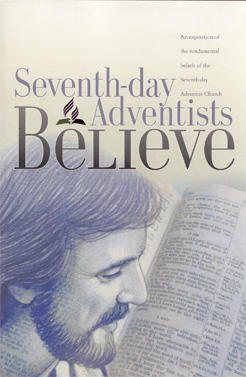 For 17 years the book, Seventh-day Adventists Believe...A Biblical Exposition of 27 Fundamental Doctrines, has been the standard resource for those seeking to understand the Biblical basis Adventist theology. But with the adoption of a new Fundamental Belief at the General Conference session this summer, the old Adventists Believe was made obsolete, being short one belief. Two weeks ago the Adventist Ministerial Association announced the publication of the new Seventh-day Adventists Believe, a soft cover featuring an exposition of all 28 Adventist Fundamental Beliefs.
When I first read this news I wasn't too excited. It looked like a resource book I wanted, but not something I was going to run out and buy. Then I read this:
This single volume shows in detail how each belief is grounded in the Bible and focused on Jesus Christ. The different beliefs, or doctrines, emphasize different facets of Christ'’s lovely character. Each one reveals more of what He is like and what a relationship with Him means. (Ministerial Assn.)Now that's what I'm talking about! My personal ideal is that each doctrine I believe will enhance my experience of Jesus, and if it doesn't, there's something wrong. But often rational analysis of theology has taken me far from that ideal of balancing the extremes of intellect and emotion. And I find that most religious books excel in either one category or the other but rarely form a union of the two.
"Grounded in the Bible and focused on Jesus Christ"--Yes, that's where we need to be. This doctrinal starting point of the new Adventists Believe is one that the church desperately needs. I only hope the contributors and editors pulled it off. I'll post a review once I've finished the book (my copy's in the mail) and seen if it lives up to my expectations.
You can order the book from your local Adventist Book Center or online at the Ministeral Association website.
Monday, September 05, 2005
Sermon Summary 9-3

The theme of good vs. evil is in the heart of all human beings; we see it in songs, novels, movies--all human stories. I believe the reason for this is that the theme of good vs. evil is being played out in the spiritual lives of all human beings. We know we should be good, but evil is so difficult to defeat, even in our own hearts.
The Bible says that God has an exclusive claim on goodness (Mark 10:18), in other words anything that is good comes from God. Therefore, if we want to know what is good we need to learn what He says is good. Any other definition of good would ultimately be self-referencing and thus meaningless.
God has spelled out what goodness is by giving us His commandments, because without them we would be in danger of making God in our image--defining Him by what we think is good. The negative commands tell us what goodness isn't (e.g. "You shall not murder." Ex. 20:13), and the positive commands tell us what goodness is (e.g. "Establish justice in the court!" Amos 5:24). Jesus said that both types of commands are important for us to obey if we want to be good (Matt. 5:17-19).
But He also said that even if we keep the rules as well as the best rule experts, it isn't enough for us to be good (Matt. 5:20). In order to be good we need the results of the Holy Spirit's work in our hearts (Gal. 5:22), and the best way to facilitate this is to look up to God and try to be like Jesus (Eph 5:1,2). Goodness is a quality that only God can give us.
Goodness cannot tolerate evil; it expresses love through correction (Eph 5:7,13). This is what Jesus was doing when He chased the money changers from the temple (Mark 11:15-17). Notice that Jesus was hardest on those who claimed to be religious but worked for evil.
Goodness is expressed and developed in community. Paul described the church in Rome as "full of goodness, filled with all knowledge and able also to admonish one another" (Rom 15:14). These are the characteristics of a good community, a community I'd like to be a part of. At first the admonish part doesn't sound so good, but the reason they are full of goodness is they help each other fight the battle against evil. Only those who really love us will graciously tell us when we're wrong, and we cannot express love in its fullest unless we are able and willing to do the same.
The painting of Christ Driving the Traders from the Temple is by the rennaissance painter El Greco.
Friday, September 02, 2005
Mayor Nagin Interview
Mayor Nagin Interview
This is a must hear audio clip. For once we hear a politician speaking the straight truth as he sees it. Mayor Ray Nagin of New Orleans delivers a damning report on the Federal response to the crisis in New Orleans. Bush may have been able to claim ignorance on September 11, but it looks like he may not be able to escape Katrina.
Make sure you listen to the whole inverivew, some of the best stuff is at the end. Not for those who are offended by mild profanity.
This is a must hear audio clip. For once we hear a politician speaking the straight truth as he sees it. Mayor Ray Nagin of New Orleans delivers a damning report on the Federal response to the crisis in New Orleans. Bush may have been able to claim ignorance on September 11, but it looks like he may not be able to escape Katrina.
Make sure you listen to the whole inverivew, some of the best stuff is at the end. Not for those who are offended by mild profanity.
Bible Studies: 9 The Life, Death, and Resurrection of Christ
Friday is again here and TGIF. Actually, I have alot of work on Fridays, so I'm going to post another Bible study. Comments and criticism are appreciated. You can look up the texts in the Bible Study Tools search box, and you can find the previous study here. As always, the 'answers' are at the bottom.
Bible Study 9: The Life, Death, and Resurrection of Christ
1. Developed. 2. Mission. 3. Morally. 4. Sacrifice. 5. Death. 6. Voluntarily. 7. Resurrection. 8. Abundant.
Bible Study 9: The Life, Death, and Resurrection of Christ
- Although Jesus’ birth was extraordinary, He d_________ in the usual, human way (Matt. 1:18-23, Luke 2:51, Mark 6:3).
- Jesus m________ was to bring about the Kingdom of God (Luke 3:23; Mark 1:15,38,39; Matt. 12:22-28; John 20:30,31).
- Jesus faced temptation like we do, yet lived a m_______ perfect life by relying on His Father, setting us an example (Heb. 4:15,16; 1 Pet. 2:21-24; 1 John 3:4-6, John 5:19).
- Therefore, Jesus was the perfect s________ to cover our sin (Heb. 9:16-22, John 1:29, 1 Peter 1:18-20, Rev. 5:8-10).
- Jesus d_____ accomplished our rescue, reconciliation, and redemption (Rom. 1:16; 2 Cor. 5:17-19, Eph 1:7).
- The cross did not kill Jesus, rather, He v___________ endured total separation from God, the results of sin (Is. 53:4,5; Phil. 2:5-8; Matt. 27:46, 2 Cor. 5:21, John 10:14-17).
- Jesus' r____________ is the heart of Christian proclamation (1 Cor. 15:3-7, 1 Cor. 15:12-19).
- Christ’s resurrection power is able to bring a_________ life to the believer today and resurrection from death in the future (1 Cor. 15:20-23; John 11:25,26; John 10:10).
1. Developed. 2. Mission. 3. Morally. 4. Sacrifice. 5. Death. 6. Voluntarily. 7. Resurrection. 8. Abundant.
Thursday, September 01, 2005
Hurricane Katrina
Normally, I don't like to comment on news events like Hurricane Katrina until I've had some time for reflection. I tend to reserve judgment until the facts start to unravel themselves, and I respect the 'experts' to do the unraveling.
I guess my area of expertise has to do with the question, Why God?, which I am asked as His supposed proxy on a regular basis. And it's a question no 'expert' can answer, especially for someone whose life has been washed away. I firmly believe that there are times when questions serve us better than answers. So I think I'll come up with a list of them, and try to tackle some in future posts. See if you have any to add.
I guess my area of expertise has to do with the question, Why God?, which I am asked as His supposed proxy on a regular basis. And it's a question no 'expert' can answer, especially for someone whose life has been washed away. I firmly believe that there are times when questions serve us better than answers. So I think I'll come up with a list of them, and try to tackle some in future posts. See if you have any to add.
- Why didn't the government invest in better dikes or hydraulic sea walls? The Dutch seem to do pretty well living below sea level?
- Why didn't the government do more when they knew the hurricane was going to make landfall near New Orleans? Why didn't they have hospital ships, relief supplies, national guard troops on the way before hand? Sure, they didn't know it was going to be this bad, but they knew it was going to be bad, right?
- Does God pour out judgments of sin cities like New Orleans? Do only the evil suffer when he does it?
- If Jesus could calm a storm on Galilee, why not Katrina?
- Who makes it a disaster, the storm or the human response to it? Why all the looters and gunmen? Who's really the bad guy here? Why did they build the stupid city there in the first place? Why don't we ever learn that you can fight nature and win? Why would anyone refuse to leave?
- How do you rebuild after something like that? Should New Orleans be relocated?
- Why is it that the poorest and most vulnerable get screwed? Shouldn't our society protect such people? Isn't that what the government is for?
- How can a just God allow innocent children to suffer?
Subscribe to:
Posts (Atom)